
In the 90’s I was working full time at a different bank than I am now, and was studying for a master’s degree in Human Computer Interfaces, or HCI. It was later renamed to User Experience, as UX sounded better than HCI. During that time, I took lessons I learned from Bruce Lee and merged it into my understanding of UX. Bruce lee believed that you were currently at a level, and to proceed to the next level of enlightenment you need to learn a lesson. Once you learned that lesson, you could progress. His original drawing for the Game of Death is below:
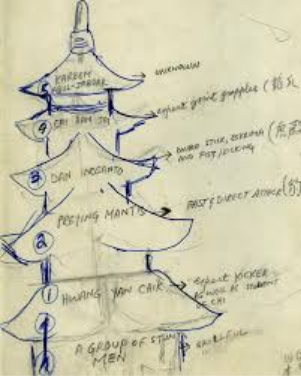
My tower describing UX development is this (thanks to Nano banana its nicer)
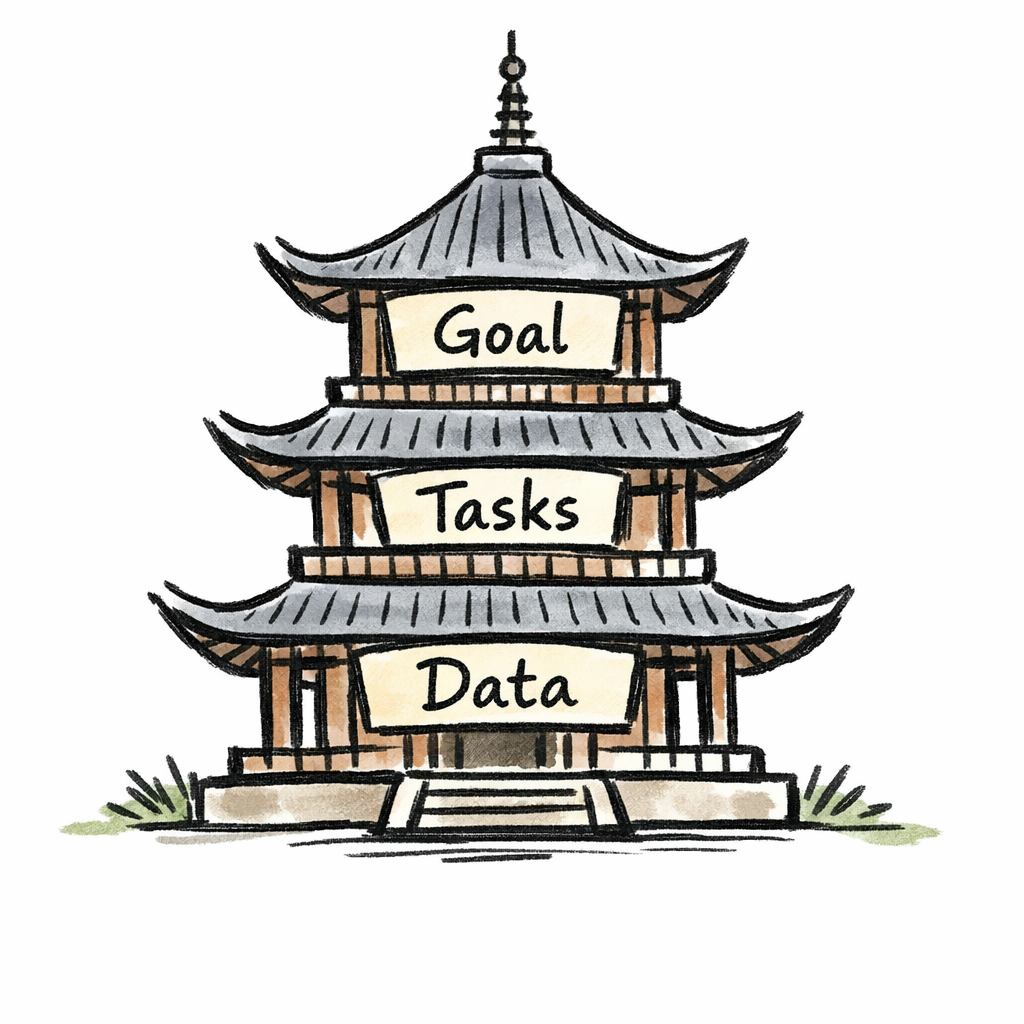
My belief was that to build a great UI, you need to first understand the Data, then the users’ Tasks, and finally the users’ goals. I have given lectures on this but just think from the original MP3 players which made you rip CDs, then copy them with another tool for the MP3 player, and a third tool on the MP3 player to listen. Very task driven. Whereas when the iPod was released, Apple thought about the goal of music enjoyment, and it was one software to acquire music and listen to it.
In 2023 I wrote my first blog post about AI, I talked about it as a great pair programmer. It could take a prompt and write code, or I could give it code and debug it. If you understand pair programming, it was good at it. Life was good, but I did not realize that this was the “Data Layer” of AI and programming.
Late last year I discovered Specification Based Development (SBD), in the form of planning mode in Claude code, and in open-source tool kits like Speckit. In SBD you start with and requirement, and it walks through several processes:
- Specficy – This helps you document your requirement
- Clarify – This helps get some details about your requirements, think about things like functional and non-functional parts of the requirement.
- Plan – Come up with a plan on how you want to implement
- Tasks – generate small measurable tasks, that can be coded
- Implement – the actual coding.
I have used this in my personal coding, as it helps me get my ideas straight and often drives the final product in a direction I was not expecting. To me this was pair programming but now with a Business Analyst helping me build a system.
What I was not prepared for was now what is called the year of AOC. This is “After Open Claw.” I am 29 days (about 4 weeks) into playing with it so technically it is 29 days AOC. When I first started using it, I thought wow this is cool, and wow this has some serious security holes. I had to put this on segregated machines, and put it in front of a proxy, and use a local model on a machine we call at home the F1 Beast.
The first thing I had it do was build a news aggregator which would take a whole bunch of RSS feeds and twice a day send me the articles I should read, and a TL;DR. This saved me a lot of time, as I would go through a lot of articles and waste a lot of time finding great reads. I had given it articles I like, and do not like and had it score each article on the scale of 1-10 on what it would think I like. This was cool. This weekend I had some extra time and installed a few clones of Open Claw and decided to also build one of my own. While working on my own using SBD, the questions I was getting back got me thinking.
Instead of giving the tool a requirement, let me give it a goal. I said “I want you to help me become a better person, friend, parent, son, brother, and human being. What can you do to help me achieve this goal?” Looking back at the Tower, I just went from Data and Task to Goal. I did not give it what to build, I did not give it any requirement other than help me reach my goal. I did this with Open Claw, Agent0 and my homegrown bot, just to see what it would produce. What all three did was research and come back with some ideas. They all asked questions, and I responded and gave me a list of things that I could pick from what to track, etc. I gave it some feedback, and the bots went and started building the system. I was thinking the whole “Where did it get these ideas from?” One of the final products was a dashboard (showing only limited info not to show too much) is below:
What you do not see is the interactions to get this data. It integrated telegram commands so I can log any of this information. It also created an automated check-in where it sends me messages asking, “Did you work out yet?” or “What is your mood?” etc. I can also use some commands used via telegram to log without being prompted. This was MVP1 (on Agent0) if you know, but they all ended up close to the same. What is interesting is that it created a calculation of how I am doing throughout the day. Yes, I only have one day of data, as it was just done yesterday.
Some functionality I could add would be connection to my Apple Watch Data, but right now I want to enter it manually, as security is a concern. Tabs up top which is interesting is it asked me about eating and what do I do. I said I meal prep, it asked where my recipes are, I said I get stuff from Instagram. What it built was a way to send it a link to an Instagram post, and generate the recipe, and I could add it to a shopping list. In Telegram and can request to see my shopping list when at the market. I could go on and on about the functionality but need to get back to my post.
The Power of these tools like Open Claw was not that it could build code for you, or be a personal assistant, but it could make Goal Based development available for non-developers. Could I do the same with Claude Code, Codex or Gemini CLI? Absolutely, in fact when Opus 4.5 was released one thing I tried was asking it to build me a SaaS product for generating $1,000 a month in income that was completely stand alone and that needed no assistance from me. It produced several ideas, built it, and walked me through setting up how to get payments. I stopped deploying it to production, was I would need to figure out how to advertise it and spend money driving traffic. I’m not ready for that yet. These tools really need developers to help it, where Open Claw can interact with a user via WhatsApp or Telegram. The run on Mac Minis and Mac Studios to run it, as well as local models is crazy right now.
So now I have updated my diagram for the AOC age.
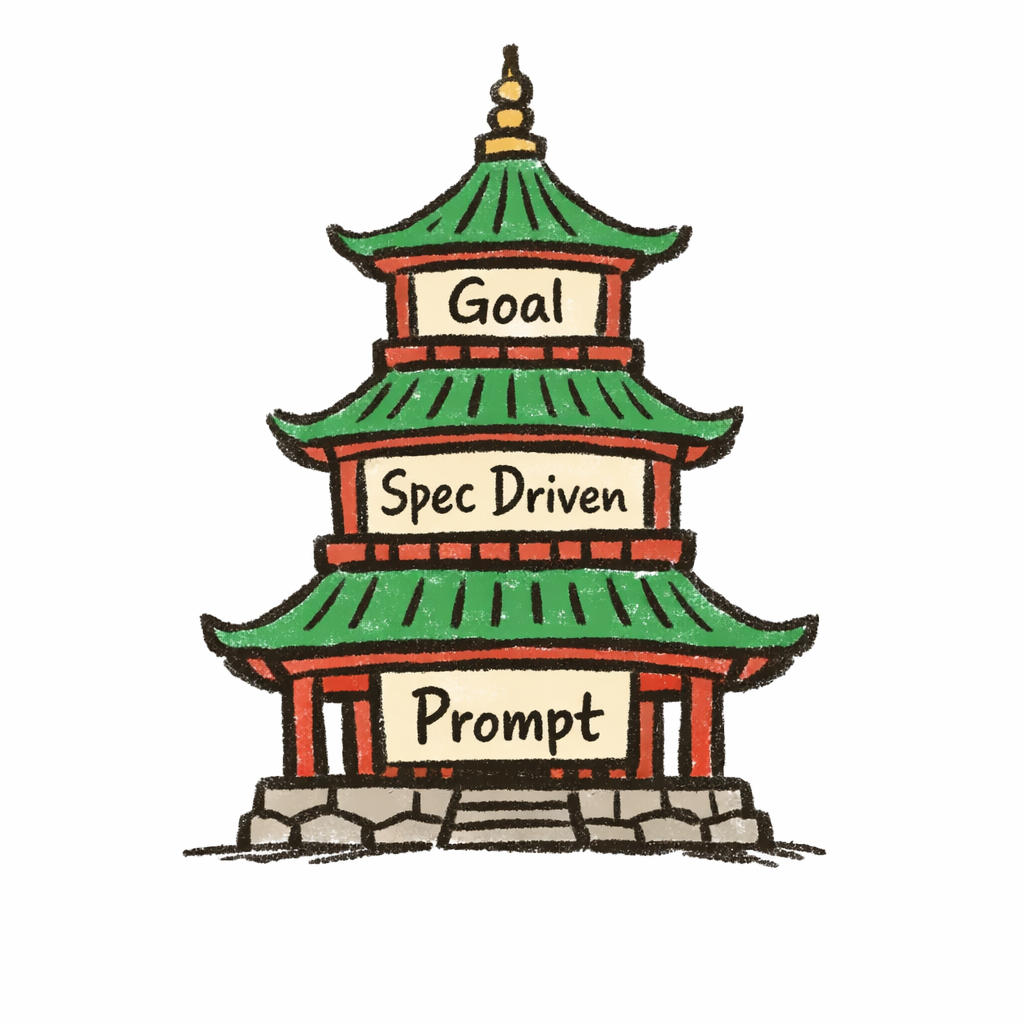
Again thanks to Nano Banana.
The power of these tools is there; there are security issues, but that will be remedied.
This opinion is mine, and mine only, my current or former employers, have nothing to do with it. I do not write for financial gain; I do not take advertising, and any product company listed was not paid. But if you do like what I write, you can donate to the charity I support (with my wife who passed away in 2017) Morgan Stanley’s Children’s Hospital or donate to your favorite charity. The fundraising site had to be restarted, and NYP Hospital made changes to their donation sites. I pay to host my site out of my own pocket; my intention is to keep it free. You can comment, but note it is moderated, and spam will be removed.
This Blog is a labor of love and was originally going to be a book. With the advent of being able to publish yourself on the web, I chose this path. I will write many of these and not worry too much about grammar or spelling (I will try to come back later and fix it) but focus on content. I apologize in advance for my ADD as topics may flip. I hope one day to turn this into a book and or a podcast, but for now it will remain a blog. AI is not used in this writing other than using the web to find information. Images without notes are created using an AI tool that allows me to reuse them. And as always spelunz iz opshunal.
Leave a Reply